Acknowledgementz
Anki - GNU - Damien Elmes
Anki Deck - CC4.0??? - Nikoo Walker
Ankidroid - GNU - Various
Aozora - Mixed Copyright Usage - Noguchi Eiji and Noriko Miyagawa.
Daily Japanese Thread Forum - Copyright - Alexander Vovin, Thomas Pellard, Sven Osterkamp, Ixrec and kWhazit.
DBpedia - GNU Free Documentation/CC3.0 - Wikipedia/Wikimedia/Wikidata
Electronic Dictionary Research and Development Group - CC4.0 - James William Breen
COMPDIC - Japanese-English Computing and Telecommunications Terminology File
EDICT - Japanese-English Electronic DICTionary File
EDICT-R
ENAMDICT - Japanese Names File
JMDICT - Japanese-Multilingual Dictionary File
JMnedict - Japanese Multilingual ? English Dictionary
KANJD212
KANJI DIC
KANJIDIC2
RADKFILE/KRADFILE
JMdict Database system - CC4.0 - Stuart McGraw
Kradfile2/kradfile-u - Uncertain/CC4.0 - Micheal Raine/Jim Rose/Breen
WWDIC - Uncertain - Charles Abbott, James Breen, Paul Blay, muchan and Kouji Ueshiba, Jeffrey Friedl, Peter Galante, Chuck Musciano and Bill Kennedy (authors of the O'Reilly HTML book), Otfried Schwarzkopf, Jamie Scuglia, Brodie Thiesfield, Shoji Yamazaki and Bart Mathias, Kendon Stubbs and Susan Munson (UofV), William Maton (Canada), Masayuki Toyoshima (Japan), Warren Togami (Hawaii), Jacek Rutkowski (Poland and EU), Jens and Ola (Sweden), Folken Lacour de Fanel (Chile), Sarwono Sutikno and Mr Waskita (Indonesia); and 'the many people who have emailed suggestions and messages of suggestions and messages of support.'
Enquire Within Upon Everything (1856-1894) - Public Domain - Robert Kemp Philp
Gutenburg - The public
Imabi - See Review- Seth Coonrod and Taylor V Edwards.
Jeffrey's Japanese-English Server - Steve Russell, Miki Allen and Satoru Murata
Jpop Project Radio - Various Copyright Licenses/AR? - Ramgah Enterprises/Aiko J,/Mosaica/Ami/ torontocast.com
J-Reibun - Copyright Material - Suzuki Tomomi. Contributors include Yoshiba, Junko Asano, Ryoko Ieda Akiko, Yoko, Oyama Yuuri, Oka Yoko, Kajikawa, Katsuya Kato Rie, Shibuya Hiroko, Tamaru Nozomi, Nakamura Ami, Nishijima Eriko, Noda Taishi, Haruna Fujimura and Yasuko Mitani.
Jsho - Various CC2.0-4.0/Copyright - Richard L
Jisho - Various CC3.0/GNU Free Documentation - Kim Ahlström/Miwa Ahlström/Andrew Plummer
kanjivg2svg - CC3.0/GNU Free Documentation License - Jisho
KanjiAlive - CC4.0 - Aiko Kojima, Arthur Christoph, Arno Bosse, ARTFL Project, Camelia Nakagawara, Cornelia Bailey, Chad Kainz, Charles Blair, Coji Morishita (of M+ Fonts), Dale Mertes, Don Harper, Eric Ginsburg, Eric Volpert, Fritz Anderson, Guillaume Iacino, Gus Lacy, Harumi Hibino Lory, Irene Kimbara, Jenny Adams, Joshua Day. Junko Nishimura, Justin Jesty, Justin Rounds, Kaylea Hascall, Karen Landahl, Keiko Yoshimura, Matthieu Felt, Mark Olsen, Matt Wilcoxson, Michael Erlewine, Mika Ishino, Makoto Watanabe (of http://mojimoji.de), Peter Thorson, Robert Voyer, Roberto Marques, Russell Horton, Sarah Arehart, Shunsuke Nozawa, Simrit Dhesi, Tanya Gray Jones, Ted Foss and Yasuyuki Nemoto,
KanjiHeatmap - CC4.0 - PikaPikaGems
KanjiVG - CC3.0 - Ulrich Apel
kanji.sljfaq - CC3.0/CC4.0/GNU - Ben Bullock
NHK - Copyright - Fujinaga Kaoru/Isomura Kazuhiro/Eriko Kojima/Michael Rhys
MeCab - FSF 2007 GNU/GPL - Taku Kudo/Free Software Foundation
Rikai.com - Uncertain - Todd David Rudick
Rikai-kun - Uncertain - Erek Speed
Sakubi - CC1.0 - Unspecified, Alexander Vovin, Thomas Pellard, Sven Osterkamp, Ixrec, kWhazit. Martin, Frellesvig, Kawashima, Tae Kim, Yan, Steve, Seth Coonrod and Taylor V Edwards.
SKIP - CC4.0 - Jack Halpern (see http://www.kanji.org/dictionaries/features/skip.htm)
Swadesh - PD - Morris Swadesh
Tabler Icons - Partially For Profit - Paweł Kuna and 'more than 100 other contributors'
Takoboto - CC2.0 - David Collier/Adam Rotmil/Jeff Blum/Amatuka, Bamboo4 and Miki O
Jgram.org - CC2.0 - David Collier/Adam Rotmil/Jeff Blum/Amatuka, Bamboo4 and Miki O
Tanaka Corpus - Public Domain - Yasuhito Tanaka & University Students
Tangorin - CC2.0-4.0/GNU/GPL/MIT/Public Domain/Copyright - Gregory Bober/Archie Preston
Tanos - CC4.0 - Jonathan Waller
Tatoeba - CC2.0 FR - Trang Ho - BDFL
Tatoeba Wiki - CC4.0? - Tatoeba Project
Ve - PD/FSF 2007 GNU/GPL - Kim Ahlstrom
Wiktionary - CC by-SA - Wikimedia Foundation, Daniel Alston and Larry Sanger
Wanakana - Open Source Initiative MIT License - Wanikani/Tofugu
Yomiwa - Copyright/Various CC2.0-4.0 - u/Vivoun.
Yomitan - GNU 2007 - Alex Yatskov
These all have many, many people involved in these projects whom I would love to highlight if they wish to be.
Blogs
Japanese learning online: https://japaneselearningonline.blogspot.com/
Japan past and present: https://japanpastandpresent.org/en/resources/publications
Kanji Portraits: https://kanjiportraits.wordpress.com/2024/04/19/creating-a-crack-on-animal-bone-for-divination-in-ancient-china-%e7%94%b2%e9%aa%a8%e6%96%87%e5%ad%97/ (start here if you like)
https://kanjiportraits.wordpress.com/2016/07/30/the-kanji-%e6%a5%ad%e4%b9%97%e6%a5%bd%e8%96%ac%e6%9e%97%e6%a3%ae%e6%9d%a1%e6%9f%bb%e6%9f%93%e6%9c%ba%e6%a1%88%e6%a5%b5-%e6%9c%a8-tree-3/
https://kanjiportraits.wordpress.com/bushu-the-kanji-makers-video-clips/#:~:text=%E6%96%B9%E3%83%BB%E6%94%BE%E3%83%BB%E6%97%85%E3%83%BB%E6%97%8F,%E5%8C%BB%E3%83%BB%E7%9F%AD%20(4%20kanji)
Naruhodo Weebly: https://naruhodo.weebly.com/blog/introduction-to-kuzushiji
Kanji Quest : https://kanjiquestblog.com/radical-list/
Pink tentacle: https://pinktentacle.com/category/art-culture/
Books
A Dictionary of Japanese Grammar series
A Dictionary of Japanese Particles - Kawashima
A grammar guide to Japanese - Tae Kim
A History of the Japanese Language - Frellesvig
A Reference Grammar of Japanese - Martin
Visualizing Japanese Grammar series
Glossary
Key:
Red is no good
Blue is good
https://www.google.com/search?q=phonogram&rlz=1C1GCEA_enJP1128JP1128&oq=phonogram&gs_lcrp=EgZjaHJvbWUqDggAEEUYJxg7GIAEGIoFMg4IABBFGCcYOxiABBiKBTIHCAEQABiABDIHCAIQABiABDIHCAMQABiABDIHCAQQABiABDIMCAUQABgUGIcCGIAEMgcIBhAAGIAEMgcIBxAAGIAEMgcICBAAGIAEMgcICRAAGIAE0gEIMjI1MWowajeoAgCwAgA&sourceid=chrome&ie=UTF-8
Active Learning: Active Learning is a sort of traditional sit down, hands on approach to language learning doing activities which occupy your full focus on the language learning activity. Something like having allotted time each day to study Anki, working through a textbook etcetera.
Agglutinative: When 'language clumps' (morphemes e.g. Cleverly is two morphemes Clever+ly) clump together to create new syntactical/semantic (definition) meanings in a lexeme (single word). For example in Japanese this is something like Kakimashita made up of 3 morphemes (Kaku+Masu+Ta) whose original or stem originally means something else as well independent of the others, but which makes a new clumped word.
Anki: SRS flashcard system
Aozora: An online free Japanese e-book site
Bigrade verb: Also known as Midan-doshi verbs, refers to when a verb-stem uses 2 kana in the Gojuon table row, can also be called a vowel-stem-verb group and is a very uncommon conjugation verb type, sometimes referred to as a 'ru verb' in language textbooks and often more common in archaic verbs nowadays with in the influx of Wasei Eigo
Bunpo: Flashcard study app, not recommended and requires payment
Causation in verbs:
Conditional mood verbs:
Conjunctions: Lexemes which connect things in a sentence/syntactical structure
Gerund: A verb functioning as a noun
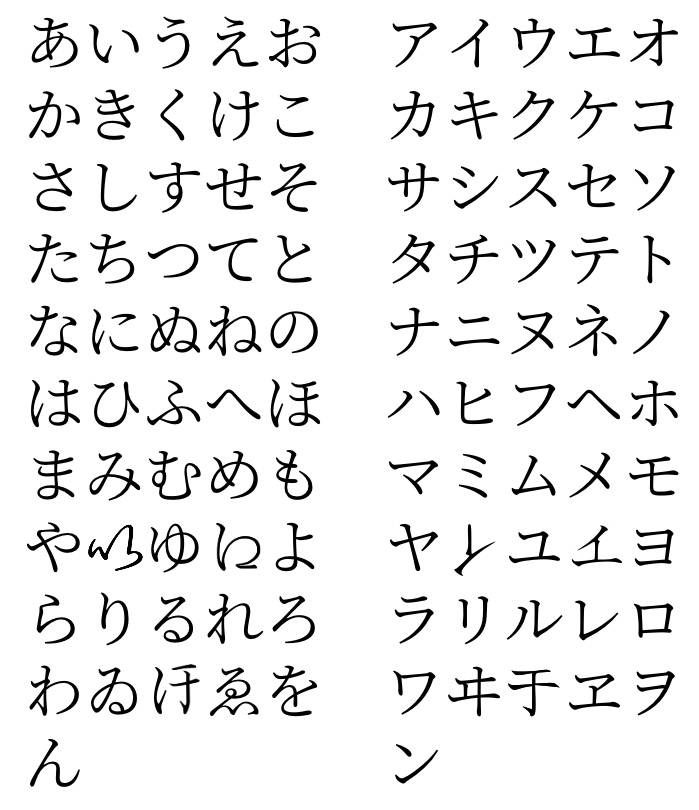
Gojuon: The traditional phonetic Kana table system, see Images
Headword: A word functioning as the heading of a structure, e.g. A in the Dictionary
Heatmap: In language learning, where you are most using something visually
Heuristics: Mental shortcuts used to find more standard/easier ways of learning
Imperative verb:
Jim Breen: The grandfather of free Japanese learning on the interwebs
JLPT: Japanese Language Proficiency Test
Jouyou: 2000 base words used to learn Japanese
Jinmeiyou: Names and so on
J-pop project radio: Free radio playing Japanese pop music
Jsho: Decent android dictionary
Migaku: Dictionary and webpage extension used mostly with Anki, outdated and now requires payment to access outside of Anki
Monograde verbs: Also known as Ichidan verbs refers to when a verb-stem uses only 1 kana in the Gojuon table row, and can be subdivided into the Upper (Kami ichidan) and Lower (shimoi ichidan) subgroups which refers to how early/far away a Gojuin table Kana is from the first column, can also be called a vowel-stem-verb group and is the most uncommon conjugation verb type, sometimes referred to as a 'u verb' in language textbooks
Morpheme: The smallest unit of a word/lexeme which a word can be broken up into, e.g. example being ex-am-ple for example and still makes some relevant sense to its language users
Negation in verbs:
NHK: National Broadcaster in Japan
NHK Easy: Early level Japanese reading materials of the news from NHK
Nomenclature: The system used to name things in a particular field or grouping
Nominalization: When a word that isnt a noun, is used as a noun, or head of a noun phrase (e.g. the blog, blog is the head of the noun phrase as it is the central element of the noun phrase), in English nominalisation looks like this stable -> stability, because 'to stable' sounds kinda
Okurigana: Kana suffix endings to stem-verbs, 使う ( Tsukau | つかう ) has tsuka as the stem, U as the Okurigana suffix
Particles: Small lexical units in Japanese which act in many ways, including conjugation and conjunctive properties
Passive Learning: Passive is a sort of modern, laid back approach to language learning doing activities which occupy your background focus on the language learning activity, most often as language input. This is to help your brain get used to little everyday things in language that textbooks unless interactive cannot provide. Examples include listening to spoken japanese alone, playing video games, having your phone set up in your target language, having an online language exchange partner etcetera. These may seem to be language output to you at first, but on actually needing to speak to a human being and not your interactive textbook, these methods help you have confidence in your own language output later on. They go hand in hand, and help your output come more naturally than simply using active learning which will orepare your very well for : Kore wa pen desu, not so much actual human conversations.
Passive verbs:
Pentagrade verbs: Also known as Godan verbs refers to when a verb-stem uses 5 kana in the Gojuon table row, and can be subdivided into one of the 10 Gojuin Rows (I know theres techinally 11 but its old fashioned anyway so also ignore the archaic Yi and Ye as well!!!!) as kinda subgroups like the Ma-Row Pentagrade Conjugation Verb subgroup and is the most common verb conjugation system, can also be called a consonant-stem-verb group
Phoneme: A unit of language which constitutes one sound
Quadrigade verbs: Also known as Yodan-doshi verbs, Archaic verbs which would have followed the same 4 Gojuin Kana verbs model, now considered part of Classic Japanese
Relative Pronoun: who, whose, whom, which, that, A pronoun which gives you more information about something that came before (antecedent) in a relative clause
Rikai: Extension for reading Japanese in a webpage
SLJFAQ: Online drawing Kanji reader
SRS: Spaced Repetition System
Subadub: Outdated audio stripping tool used for Netflix at one point or another
Syllable: A unit of language which constitutes a group of vowel sounds, often a morpheme
Tae Kim: Grammar Guide Textbook See: https://www.guidetojapanese.org/grammar_guide.pdf
Takoboto: Grammar Dictionary group
Tangorin: Website for example sentences
Target Objective Verb: Makes a verb objectivate in a sentence, in English transitive+object
Tatoeba: Sentence Corpora Project
Tense: A grammatical function which modifies the meaning of a word, usually to change time, space or place
Transitivity: When something describes something in motion or a general sense of movement
Trigade verb/Class 3 verbs: Irregular verbs because Japanese, usually just verbs such as suru/kuru
Verb Stem: The original morpheme of a conjugated verb which carries the most important meaning in that agglutinative conjugation verb clump.
Volitional verbs:
Wasei Eigo: Japanese which originates from English
Yomiwa: Recommended android dictionary and photo translator app
Images


Methodologies
LJ43 Methodology: My own recommended goes as follows, Hiragana, Language Input, Language Density, Katakana, Pronunciation, Stroke Order, Kanji, Vocabulary, Grammar, Language Exchange, Tests and Certificates, Cultural Input. You should cover apart from testing, all of those bases, not always in that order but that is the way I as a kinaesthetic learner have found the easiest to do. I also believe that you can do as little or as much as you want in a day, input included in that. So 5 minutes is good, 9 hours is better, all day probably optimal. All is good. What matters is that you getting used to the language and enjoying it.
1) Hiragana: The first 50 phonetic commonly used characters
2) Input: Spending time with any Japanese language media in any medium
3) Density: Spending an increased amount of time with Japanese media and language resources
4) Katakana: 50 foreign language phonetic characters
5) Pronunciation: Starting to learn Pitch Accent and phonetic conjugations
6) Stroke Order: Beginning with Hiragana, learning correct stroke Order helps save time later on
7) Kanji: This is the reading not the meaning of Kanji, following the Heisig RTK method
8) Vocabulary: This is learning terms and matching them to Kanji where you can, helps save time down line for polysemic reasons
9) Grammar: Learning how the bits of the language get put together to make any sense
10) Language Exchange: If you can, find a language partner to have conversations exchanging languages together
11) Tests and Certificates: Mostly just pieces of paper, but important in many ways at the end of the day
12) Cultural Input: Start researching the culture behind why you keep finding weird Kanji and becuase cultural appreciation
AJATT: All Japanese All The Time, refers to the idea that all of your input should come from things like personal devices being switched to Japanese | For more see: https://www.reddit.com/r/ajatt/comments/1bq7x2v/has_anyone_here_used_the_ajatt_method_to_learn_a/
Crosstalk: Essentially, you talk to your desired language partner in your native language, and they talk back to you in their desired language. Nice idea in theory, in practice having tried this very method with a very good support network (German and English), this method is very tricky to get right and cumbersome if you have a life outside of studying the language. Good for input, enunciation, cultural and social purposes but not a particularly compromising method which would allow non-heritage speakers to get very far. But give it a try if you can. | For more see https://www.dreamingspanish.com/blog/crosstalk
Moe: This for me is a nope. Like from a linguistics point of view, definite nope. Links to sources which contradict each other, is a jumbled, garbled mess of different points of view and generally doesnt allow you much choice over how you learn. Nor ar alternative versions of things offerred, which rather like Tofugu means certain things are prioritised over others you may find more useful than I do. The method seems, there, but I do not recommend this one. 2.6 of the guide is decent, but the rest is pretty banal, overcomplicated stuff. Kana supposedly is meant to take a month. I laughed at this becuase it took me and a friend a week to learn the phonetic alphabets, sounds and stroke order. Immersion is important yes, but obsessive input can be a no-no for so many reasons. | For more see: https://learnjapanese.moe/guide/ .
Passive Podcasts: Listening to podcasts in the background. You can also look up the transcript, create your own or make vocab lists for your Anki in this way, but I recommend this more as a passive learning input methodology.
Refold: On the whole, the Refold method is to just have input a beginner can understand. Essentially the same message I promote in their marketing and slogans, without the free part. Treating the learner like a bit of an idiot, they claim no user comes to a language with prerequisite knowledge and is completely blindsided by issues like culture, grammar and enunciation. I would say this is a pretty prescriptivist attitude that stifles creativity, ingenuity, novelty and diversity. You do not need to pay to learn a language, languages are free knowledge. The issue this brings however, is that input only learning is confusing. I only began to learn to speak after years of fumbling beginner input study and more input, and began doing immersion learning with a lanuage partner. This is my ideal learning path, yours is most likely to not be the same. The idea that all learners just need the correct type of input is rather trite and dimissive of the other kinaesthetic, visual, auditory etcetera learners. It is also more than enough to just do 10-15 minutes learning a day if you are busy, or have problems with focusing for example. ADHD is not a lifestyle change away from fluency for example. Naughty refold. | For more see: https://www.reddit.com/r/Refold/ .
Wanikani: Not free but often recommended, essentially a giant amount of time and money from free work so nah for me,
Websites
Anki: www.ankiweb.net
Kanji Deck : https://ankiweb.net/shared/info/1044119361
Altaica: https://altaica.ru/japanese_corpora.html
Aozora: https://www.aozora.gr.jp/guide/aozora_bunko_hayawakari.html
Bensei: https://bensei.jp/index.php?main_page=product_book_info&cPath=9_13_33&products_id=103793
Bunka Joyo Kanji: https://www.bunka.go.jp/kokugo_nihongo/sisaku/joho/joho/kijun/naikaku/pdf/joyokanjihyo_20101130.pdf
DBpedia: https://www.dbpedia.org/about/
IchibanNihongo: https://nihongoichiban.com/home/japanese-grammar-particles/
https://nihongoichiban.com/home/hiragana/
https://nihongoichiban.com/home/katakana/
https://nihongoichiban.com/2011/03/21/what-are-onyomi-and-kunyomi/
Imabi: https://imabi.org/
What is Japanese?: https://imabi.org/what-is-japanese/
Yojijukugo: https://imabi.org/idioms-iv-yojijukugo/
Gutenburg: https://www.gutenberg.org/files/3206/files/japanese.txt
https://www.gutenberg.org/cache/epub/3206/pg3206.txt
Japanese learning online : https://japaneselearningonline.blogspot.com/2015/03/7-japanese-kanji-radicals.html
Jeffreys Dictionary: http://rut.org/cgi-bin/j-e/jis/dict
Jeffreys server: https://www.trussel.com/f_nih.htm
Jim Breen's WWWJDIC: https://nihongo.monash.edu/cgi-bin/wwwjdic?1C
Jisho: https://jisho.org/
J-pop project radio: https://www.j-popprojectradio.com/listen/
Kanji.org: http://www.kanji.org/jack/unicycle/uniconx/trip.htm or kanji.org
KanjiAlive: https://app.kanjialive.com/search
https://kanjialive.com/wp-content/uploads/2012/09/intro-to-kanji.pdf
https://kanjialive.com/214-traditional-kanji-radicals/
Kanji Code: https://thekanjicode.com/japanese-phonetic-components/
Kanjikoohii; https://kanji.koohii.com/learnmore
Kanji Link: https://www.kanji-link.com/en/kanji/intro/
https://kanjialive.com/wp-content/uploads/2013/02/214_traditional_radicals.pdf
https://www.kanji-link.com/en/kanji/grade/
Kanji Heatmap : https://kanjiheatmap.com/?
Kanji VG: https://kanjivg.tagaini.net/
Kanji Wakaru: https://kanjiwakaru.com/kanji/#JLPTkanji
Kanshudo: https://www.kanshudo.com/collections/joyo_kanji
LTL Bank: https://ltl-japanese.com/grammar-bank/adjectives/
NHK Easy: https://www3.nhk.or.jp/news/easy/
Nihongo Shark: https://www.nihongoshark.com/post/kanji-by-sight
Nihongodera: https://nihongodera.com/tools/kana-converter
NINJAL Corpus: https://clrd.ninjal.ac.jp/csj/en/
Open Knowledge Foundation : https://okfn.org/en/who-we-are/
OER Commons: https://oercommons.org/search?search_source=homepage&f.search=kanji&f.general_subject=&f.sublevel=&f.alignment_standard= (community college resources)
Rikai: http://www.rikai.com/perl/Home.pl and https://chromewebstore.google.com/detail/rikaikun/jipdnfibhldikgcjhfnomkfpcebammhp
Reddit: https://www.reddit.com/r/LearnJapanese
Sakubi: https://sakubi.neocities.org/
Semiotics: https://navymule9.sakura.ne.jp/semiotics.html
Sketch Engine: https://www.sketchengine.eu/corpora-and-languages/japanese-text-corpora/
SLJFAQ: https://kanji.sljfaq.org/draw.html
StudyKanji: http://studykanji.net/
Swadesh: https://en.wiktionary.org/wiki/Appendix:Old_Japanese_Swadesh_list
Tae Kim: https://guidetojapanese.org/learn/grammar/tendency
Takoboto: https://takoboto.jp/
Tandem: https://tandem.net/blog/conjugate-verbs-japanese
Tanos: https://www.tanos.co.uk/jlpt/
Tangorin: https://tangorin.com/sentences
Tatoeba: https://tatoeba.org/en/sentences/show_all_in/jpn/none
Transifex : https://explore.transifex.com/search/?q=kanji
Wakaru Rekishi: https://wakaru-rekisi.com/
https://en.wikipedia.org/wiki/Praxis_(process)
Wikipedia:
Adjectival Nouns (-na) - https://en.wikipedia.org/wiki/Adjectival_noun_(Japanese)
Binding - https://en.wikipedia.org/wiki/Binding_(linguistics)
https://en.wikipedia.org/wiki/C-command#Binding_Theory
https://en.wikipedia.org/wiki/Government_and_binding_theory
https://en.wikipedia.org/wiki/Logophoricity
https://en.wikipedia.org/wiki/Principles_and_parameters*
Japanese conjugation - https://en.wikipedia.org/wiki/Japanese_conjugation#Verb_groups
Conjugation addendum - https://en.wikipedia.org/wiki/ Japanese_conjugation_(mizenkei_base)
Mono/Pentagrade verbs - https://en.wikipedia.org/wiki/Japanese_godan_and_ichidan_verbs
214 Radicals - https://en.wikipedia.org/wiki/List_of_kanji_radicals_by_stroke_count
Pronouns - https://en.wikipedia.org/wiki/Japanese_pronouns
Nominalistion - https://en.wikipedia.org/wiki/Nominalization#Japanese
Pitch Accent - https://en.wikipedia.org/wiki/Japanese_pitch_accent
Adjectives - https://en.wikipedia.org/wiki/Japanese_adjectives
Grammar - https://en.wikipedia.org/wiki/Japanese_grammar
G addendum - https://en.wikipedia.org/wiki/Japanese_grammar #Distinctive_aspects_of_modern_Japanese_sentence_structure
仮借 - https://ja.wikipedia.org/wiki/%E4%BB%AE%E5%80%9F
Particles - https://en.wikipedia.org/wiki/Japanese_particles#bakari_ka
Poetry - https://en.wikipedia.org/wiki/Japanese_poetry
Praxis learning - https://en.wikipedia.org/wiki/Praxis_(process)
Kangxi Radicals - https://en.wikipedia.org/wiki/Kangxi_radicals
Radicals by Frequency - https://en.wikipedia.org/wiki/List_of_kanji_radicals_by_frequency
Scrambling - https://en.wikipedia.org/wiki/Scrambling_(linguistics)
Yupian - https://en.wikipedia.org/wiki/Yupian
Dictionaries - https://en.wikipedia.org/wiki/List_of_Japanese_dictionaries
Tenrei Meishi Bango - https://en.wikipedia.org/wiki/Tenrei_Bansh%C5%8D_Meigi
World of Japanese: https://www.theworldinjapanese.com/if-you-want-to-learn-japanese-learning-kanji-is-essential/
Yomitan: https://yomitan.wiki/
https://yomitan.wiki/yomitan-pdf-viewer/web/
YomiNinja: https://github.com/matt-m-o/YomiNinja/releases
*https://www.google.com/search?q=what+is+i+language+in+linguistics&oq=what+is+i-language+&gs_lcrp=EgZjaHJvbWUqCAgEEAAYFhgeMgYIABBFGDkyCAgBEAAYFhgeMggIAhAAGBYYHjIICAMQABgWGB4yCAgEEAAYFhgeMggIBRAAGBYYHjIICAYQABgWGB4yCAgHEAAYFhgeMggICBAAGBYYHjIICAkQABgWGB7SAQg4NjczajBqN6gCALACAA&sourceid=chrome&ie=UTF-8
https://www.google.com/search?q=extended+projection+principle+linguistics+japanese&sca_esv=552fb68e3d08662a&sxsrf=AE3TifPmD_dBCSO6zQs6U32UZ3mrEGx90Q%3A1760510093731&ei=jUDvaKGrLO3e2roPoJerwQU&ved=0ahUKEwjhpYqWy6WQAxVtr1YBHaDLKlgQ4dUDCBA&uact=5&oq=extended+projection+principle+linguistics+japanese&gs_lp=Egxnd3Mtd2l6LXNlcnAiMmV4dGVuZGVkIHByb2plY3Rpb24gcHJpbmNpcGxlIGxpbmd1aXN0aWNzIGphcGFuZXNlMgUQIRigATIFECEYoAFIoyVQuQJY_CFwAXgBkAEAmAHeAaABkg6qAQUwLjQuNbgBA8gBAPgBAZgCCqAChQ_CAgoQABiwAxjWBBhHwgIFECEYnwXCAgQQIRgVwgIHECEYoAEYCpgDAIgGAZAGCJIHBTEuMy42oAfBJ7IHBTAuMy42uAfvDsIHBTItNy4zyAdC&sclient=gws-wiz-serp
https://www.google.com/search?q=binding+theory+and+c-command&oq=binding+theory+and+c-command&gs_lcrp=EgZjaHJvbWUyBggAEEUYOTIGCAEQRRg80gEJMTYwMDdqMGo3qAIAsAIA&sourceid=chrome&ie=UTF-8
Youtube Advice
Yan and the Japanese People (Let's Learn Japanese 1&2).
Socials
Email : learnjapanese43@gmail.com
Wikimedia: https://commons.wikimedia.org/wiki/User:LearnJapanese43
Discord : @learnjapaneseforfree
Tiktok : @learnjapaneseforfree
Youtube: @learnjapaneseforfree /LJ43?
This review is part of the Learn Japanese for free project. I have, do not and never will derive any profit from this project. Please send any requests, questions or further information about free tools for learning Japanese to learnjapanese43@gmail.com which is checked every 2 weeks.

_-_planche_216.jpg)


No comments:
Post a Comment