Pedantic Introductory Stuff
So you may have noticed that verbs are a bit different to English in Japanese. You may have also heard this purely referred to as godan/ichidan, or Ru/Eru verb conjugation. Becuase I don't like treating people like idiots, feel free to take from where you need here, becuase I will do a linguistics student and give you the full thing, more than you chew and all. These are a very small part of the wider lingusitical considerations that come from the study of the Japanese language. Ultimately however much you choose to look over and take away with you or return back to and go, "THATS WHY THAT WAS THERE!", is up to your individual; or borg collective perhaps; needs, wishes, whims and fancies. Please skip to the Actual Verb Conjugation section if you know all the pedantic introductory content therefore.
/*~*/~~*
Verb Conjugation is long and complicated over on Wikipedia so I endeavour to make it make sense here instead. Conjugation does not have a lot of literal translations into English, and conveys different meanings. Things like numbers, gender and individual references and other social constructs are usually directly left out. They express things like negation, present/past tense, volition, passive voice, causation, imperative and conditional mood, ability, conjunction and changes that come with specific particles.
Schmancy Fancy Grammar Words that arent so Fancy and more so Schmancy
Or Words you might not know explained in Simple English because Elitist gatekeeping is gross
Schmancy fancy terminology such as 'inflectional suffixes' may come across as either foundational or daunting depending on who you ask, however really they are just what we are describing and they aren't as scary as they may first appear, you simply need to guide yourself through them to understand what it is you are looking at and for to understand them. Therefore here are our main heuristically presented ones:
1) Stem
Stem simply refers to the main part of the verb you are looking at.
2) Inflectional suffix
Some letters on the end of a verb.
3) Agglutinative properties
When letters sort of clump together.
4) I-adjectives
Not really something you need to worry about as its a bunch of textbook drivel IMO in relation to this topic as a standalone learning topic, but definitely useful in a wider context.
5) Adverbial phrase
INCREDIB-LY easy to spot in English, becuase its basically an -ly word in English.
Pedantic Introductory Stuff End
Instead with Japanese we are more likely to describe these nonsensical functions that textbook drivel refers to as simply Adverbial phrases, or Adverb+Auxiliary verbs in the closest thing we have to in English, as you may have noticed that verbs are a bit different to English in Japanese.
Please excuse the giant verb charts, but otherwise they get very blurred. You can find them on Wikimedia otherwise.[1] These charts are useful for revision, if you need a further explanation of Actual Verb Conjugation, see the section titled Actual Verb Conjugation.


Actual Verb Conjugation
Actual Verb Conjugation is relatively easy I would say to understand. You have your Verb grades and Verb Bases systems which help certainly English speakers to get to grips with how Japanese verbs can be used. These systems are built on the older Gojuon Kana table which is outdated/archaic, but a useful tool for learning modern Japanese nonetheless.
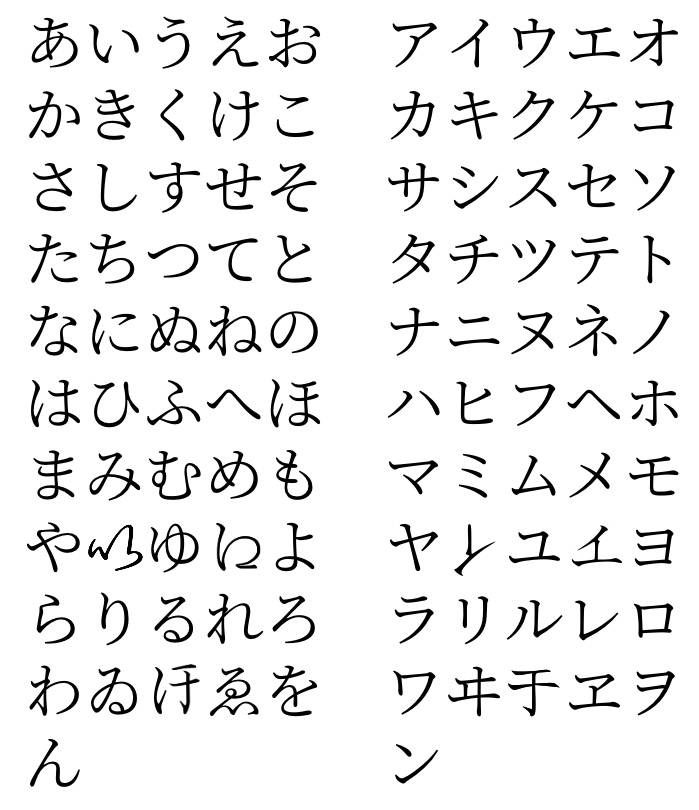
The Gojuon is the traditional phonetic chart. Please note some of these Kana are not in modern usage. You may have heard of the classic 'Ka Ki Ku Ke Ko'. But wait, now there's more! Meet all very old Verb Grades! Verb grades (Mono/Bi/Tri/Quadra/Penta/grade) are based on the model the Gojuon. The Gojuon table used to express the number of times a verb could be conjugated by. So when looking at a monograde verb, this verb will use one in the Gojuon row, whereas pentagrade will use 5 in the row. The ending or changing part of the verb (conjugation) will change to imply the specific grammatical meaning implied in relation to a verbs grade therefore. Monograde verbs are the easiest to conjugate by simply removing the final kana, Pentagrade verbs (the most common) are conjugated
Miru is Monograde Minai, Mimasu, Miru, Mirareru, Miyo. These are also known as -ru verbs.
Yomu is Pentagrade Yomanai, Yomimasu, Yomu, Yomeru, Yomo/u.These are also known as -u verbs.
Verb Grades
1) Monograde verbs/Ichidan-doshi -
2) Bigrade verbs/Midari-doshi -
3) Trigrade verbs/Sandan-doshi?/Irregular Verbs -
4) Quadrigrade verbs/Yodan-doshi -
5) Pentagrade verbs/Godan-doshi -
Monograde, Trigrade and Pentagrade verbs are the ones you will see in modern Japanese, mostly pentagrade verbs. Bigrade and Quadgrade verbs are archaic (Classical Japanese) verbs are therefore not used in contemporary Japanese, or rare circumstances; for artistic effect or the like.
Utilising the Wikipedia examples because laziness and coherency
Miru is Monograde Minai, Mimasu, Miru, Mirareru, Miyo
The example used here is a monograde verb, with the stem being 'Miru'.
Monograde is often referred to as a verb-stem-suffix.
Yomu is Pentagrade Yomanai, Yomimasu, Yomu, Yomeru, Yomou
This example is a pentagrade verb, with the stem being 'Yomu'.
Pentagrade is often referrable to as an inflectional suffix.
Verb Bases
If Verb Grades are the way you count the verb, Verb Bases are the way to actually speak Japanese, becuase this is the part where actually can use this stuff in sentences (or, the logic of how to change the ending of a verb into what you want to actually say).
OR
Verb bases describe their Japanese linguistical construction formulae, or how different verb endings/morphemes (conjugations) change meanings.
- ) A I U E O cheat code
In order to figure out how to use the right kind of verb ending, you need to know what kind of verb you have. Either a Monograde verb (-ru verbs). or a Pentagrade verb (u-verbs).
All Japanese verbs basically, end in -u. So to find the difference, you need to find the last vowel in the verb before the -u letter.
If the vowel is i/e, its Monograde.
If the vowel is a/u/o, its Pentagrade.
This rules applies to around 95-98% of Japanese verbs, due to Trigrade verbs (irregular verbs) being the kind that you will need to remember off by heat, but depending on who you ask, theirs only like 3-15 of these so they are pretty easy to remember. For example Miru, the vowel before is -i-, so it is a Monograde. Yomu, the vowel before is -o-, so Yomu is Pentagrade.
Otherwise, return to your Gojuon chart, and find the first row of あ-お. Remembering that the majority (75%+) of Japanese verbs, I'll be using pentagrade examples, but remember that Monograde changes how the verb ending is because *agglutination language*. Without further ado, Nomu (to drink):
In the あ-お row, you will find -u (う) in the middle. Then language equation time!: [
Stem + Helper verb (Auxiliary verb) + Inflectional suffix/'Adjective'
+ Adjective
+ Noun
A stem is the main part of the verb, the nom part. The helper verb is the part that agglutinates, so for example, in Nomimasu (to drink-ish), the -mi hiragana. The inflectional suffix here is masu, which makes it the formal dictionary standard of the verb. I dont make the rules around the language. Then:
Add a little spice>: ] Nom-u No~m-u~
No + mu (is the standard form fit into the equation)
飲 +む
Stem + Inflectional suffix + Helper verb (Auxiliary verb)/Adjective
No + mi + masu (to drinketh politely)
飲 + み + ます
Stem + Adjective
No+mi + tai (to want to drink)
飲+み + たい
Stem + Noun
No+mi + mono (drink thing)
飲+み + 物
And you get the 3 ways that you can change a verb into whatever it is you want to say (this process is called conjugation). Remember to change the inflectional suffix in Pentagrade verbs to whichever hiragana is relevant, otherwise you will have some confused people asking about what you mean.
--) Ta-kei
This is just past tense. You'll often see endings being 'tta/ta', this is just the past tense version of the word you are looking at.
Example: Kau -> katta (buy -> bought)
supa ni iku -> supa ni itta (going to the supermaket -> went to the supermarket)
---) Tekei
Next is て形 (continuative form). Continuative form continues a sentence, continues what a subject/receiver of a verb is doing, or continues the story being told. It continues stuff. Formally, Tekei has 5 forms, and 'gives continuing information about adjectives'. There different versions of Tekei, which add dakuten and so tekei is all variatns of the hiragana -te.
To make a sentence, you need to remember to add -de, so a Simple sentence A+de+Simple sentence B is a valid regular sentence in Japanese. When you use these, they differentiatiate between Monograde and Pentagrade a bit in form. Mono uses verb stem+ru, into stem+te. So taberu -> tabete. Kiru -> kite etc. Pentagrade uses verb stem+-u/-tsu/-ru to become stem+tte. So kau -> katte, motsu -> motte etc. And for stem+-me/-bu/-mu becomes -nde. So shinu-> shinde, asobu -> asonde etc. There are others, but see the recap section becuase Im lazy and notes are easier to copy than they are to explain in great detail, when you need to learn the other basics first.
With adjectives (i-adjectives), all you need to do is take away the last -i and add kute.
Example: samui (cold) -> samukute (was cold)
-) samukute, kooto o kita (was cold, so I wore a coat)
-) X ga samukute, X ga kooto o kita (X was cold, so X wore a coat)
--) saikin nerenakute, karada ga darui. (recently ive-not-been-able-to-sleep, [given my] body is sluggish).
--) saikin, X ga nerenakute, karada ga darui (Recently, X is not-able-to-sleep, [their] body is sluggish)
---) nemukute, benkyou dekinakatta (was sleepy, so-was-that-I-couldn't-study)
---) X ga nemukute, X ga benkyou dekinakatta (X was sleepy, so X couldnt study then)
***A note on na-adjectives, they're made up. In Japanese linguistics, they are known as Keiyoudoshi, but unless you want to study Japanese historical linguistics/grammar; Heian on[8]; ignore them. See the copula.
Yay, now onto the long form version of the basics of tekei.
1) -te -iku/-kuru (going/coming)
Example:
motsu -> motteiku
to hold -> to continue holding
2) -te -ta/-da (continue sentences with verbs/keiyoushi ends/past tense sentences)
-te here connects nominals (when something becomes a noun, like nomu into nomimono). Mostly this is is used for pentagrade verbs which change the tense to past tense when you use -ta/da (た・だ)。 You need to remove the -i for I-adjectives (or Keiyoushi).
Example: Samui (nominal becomes) -> Samukute (in a sentence)/Samui-katta
Its cold -> Its cold and... / It was cold
OR
Kaumasu (monograde) -> Kaumashita
To buy -> bought
The only exception to this rule is ii which becomes -> yokute.
3) -te -iru (-ing basically)
Example: Okiru -> Okiteiru
To wake up -> waking up
4) -te -ha
Ha and mo (4 & 5) are the topic marking particles. (e.g. Watashi wa ningen desu; I am a human being.) -teha marks the topic, and allows you to specify what you are talking about. This lets you make complex sentences (linguistics word not a typo) in Japanese. Japanese has special ways of marking the doing and the recieving of certain verbs, so this is important to remember.
Example: Ame ga fut-teiru*. Kouen ni ikenai
Rain is falling. I didnt go to the park.
Ame ga fut-teha*, kouen ni ikanai.
Rain is falling, and so, I didnt go to the park.
*furu -> futteiru -> futeha
Topic marking examples:
Pan wa(ha) tabeta
As for bread, ate
Pan wa X ga tabeta
As for bread , X ate it.
Pan wa X ga tabenakatta
As for bread, X was not eating it.
5) -te -mo
Temo comes from でも (but). It pretty much is the continuation of a rebuttall (lol.) ORRRRR I like cats, BUT I like dogs too, types of sentences.
Example: X ga tot-temoii
X is very good
Ame ga futtemo, kouen ni iku
The rain is falling-(but), Im (still) going to the park.
Sera demo wakaru ( Monkey, but [even they] understand).
X ga sera demo X ga wakaru
As for X is a monkey, but even X understands too.
Pan mo X ga tabeta.
As for bread, X ate too.
Pan mo X ga tabenakatta.
As for bread, X did not eat too.
Compound tekei
You can also get compound verbs which attach using -te/-ta/-da. Compound verbs are basically agglutinative verbs that have been stuck together to mean something else. For example, yasmi+da, which means rest day basically which comes from yasumu to sleep and another verb which i have forgotten.
Example: Futtema+wasu can also be furi-mawasu
shake+spin same meaning
(if continued to shake+spin) (waving and swinging around your skills)
Mono+Penta same meaning
This example is used to show you the difference in what you can do with verb inflection/conjugation. Same verbs, but in the same way if you bought something, you arent buying it. Check the stem section below for more on how to conjugate the word into the correct ending.
----) Stems
These are what to do when you have I-adjectives (Keiyoushi).
-) i stem
This turns the -u into an -i.
Is the connective form for I-adjectives and also Jodoushi (Auxiliary/Helper verbs), they are flimsy and cant stand up on their own, so they need something else to help them. This is possible, because Japanese is agglutinative, and likes to stick random things together because it can. 99% of hiragana attach to i-stems. Its like hydrogen and oxygen. Loves connecting to stuff. This in fancy schmancy linguistics terminology is a nominal, and in reality, that means that you end up with the advanced i-stem examples at the end here, and fat-helper verbs (Compound-Auxiliary verbs) which are for example yasumu becoming yasumida (to rest becoming rest-day).
Example: nomu -> nomitai
to drink -> to want to drink (pentagrade)
taberu -> tabetai
to eat -> to want to eat (monograde)
tsuka-i+kata (kata here is a kanji)
the way (the kanji) of using X
hanasu+au -> hanashiau
to talk+to meet -> to discuss in person
For more see verb base recap.
-.) e stem
Is the imperative/command form (you will do X!) of the stem. It shows up also for A) -ba and B) -ru/-rareru. For Monogrades as e-stem+rareru and Pentagrades as e-stem+ru. Switch your u column to the e column on the gojuon chart here and add the relevant ending.
A) -ba examples
taberu -> tabereba
to eat -> if [X] eat (Monograde)
Nomu -> Nome
to drink -> You shall drink!
Nomu -> Nome -> Nomeba
to drink -> [You] shall drink! -> if [you] drink (Pentagrade)
B) -ru/-rareru examples (hypothetical form; e-stem+yo/+ru)
hanasu -> hanase -> hanaseru
to speak -> [You] shall talk!/if [I] talk -> I can talk (Pentagrade)
taberu -> tabere -> taberareru
to eat -> if [I] eat -> I can eat (Monograde)
Young people are making this verb grade distinction kind of redundant by using -ra removal. This looks like taberu -> taberareru into instead tabe--reru. Youtube, Watch the youtube and cross reference if you dont believe me.
-.-) a stem
A-stem is basically for negatives (-nai | not, -zu |without; and -me | not yet.) For Monograde verbs this is a-stem+rareru/saseru. For Pentagrade verbs, the a-stem adds ma, and becomes a-stem-ma+reru/sase. This is because the a column adds wa because of Old Japanese rules**** which are still in use today.
Reru/rareru is the passive/*receptive* helper/auxiliary verb. It does the recieving, e.g. Nomareru basically talks about someone/thing else drinking. It is getting something done to it.
Sase/saseru is the causative auxiliary verb. It does the causing, e.g. Nomaseru, basically means I was doing/forcing the drinking. It is doing something to something else.
Examples:
-) Shiru -> Shira-nai (to know -> to not know; Mono)
-) Nomu -> No-manai (to drink -> to not drink; Penta)****
--) Shiru -> Shira-zu (to know -> unknowing/unknowingly/the state of unknowing; Mono)
--) Nomu -> No-mazu (to drink -> without drinking; Penta)
---) Shiru -> Shira-me (to know -> to not knoweth [polite older retained inflection form]; Mono)
---) Nomu -> No-mame (To drink -> to yet drink; Penta)
----) taberu -> tabe-rareru (to eat -> probably eaten [passively]; Mono)
----) nomu -> no-mareru (to drink -> probably drank [passively]; Penta)
-----) taberu -> tabe-saseru (to eat -> doing/allowing to eat [causative]; Mono)
-----) nomu -> no-masase (to drink -> doing/allowing to drink [causative]; Penta)
****sometimes you need to add random wa hiragana in there.
-._.) o stem
This is is the volitional form (lets do x!). For monograde verbs, you do o-stem-ru+you. For pentagrade verbs you do o-stem-u+ou.
Example:
-) Taberu -> Tabeyou (to eat -> lets eat!; Monograde)
-) Nomu -> Nomou (to drink -> lets drink!; Pentagrade)
-----) Sentence enders (copula)
Sentencer enders are sentences which use i+da (copula+da), which are a sort of declarative sentence. So something like Its cold isnt it! declare that the person saying its cold, has declared their cold opinion. i+da declares stuff. This use the copula, a popular form of verb in Japanese grammar because of aru and iru which declare non-moving and moving subjects.
Example: Neko ga suki da. (Cat is likeable to me.)
Neko ga suki de, X ga Ni hikikatta. (Cats are likeable, so X has 2 [as pets]).
***Na-adjectives are basically how this functions. They are the connective form | Renyoukei of the nominal copula+da, or nominal copula+na, which is just da with handakuten. So hopefully reading about renyoukei gave you a headache and you watched the linked 20 minute youtube videos instead, because as mentioned, you dont need to know what they are. Blame textbook publishers who aren't trained to teach or study languages but who decided to do it anyway. Or don't take anyones word for it and have a good old DIY sesh with 日本語。Enjoy.[8]
Recap (note-taking laziness) section
Use Tekei to connect/continue sentences.
Use Takei to use the past tense.
With ta-form, you can use it unilaterally for negatives across the relevant conjugations (Past, polite past, and everything else uses 'nai' for Kaiyoukei | Past tense form and for the rest see the A-O stem systems). Usually they are used for verb ending clauses.
These are the general ta forms
-) tte -> tta e.g. katta / motsu -> motta /
dekinakatta**/*** (dekiru+na+katta/to study-not-was able)
Think in English. You get English.
Think in Japanese. You get Japanese. Immerse broski.
-) shite -> shita
-) nde -> nda
-) ite -> ita
-) ide -> ida
-) te -> ta
Monograde verb Recap
To find these, the vowel before is i/e.
The verb base endings are crudely for negative form: -nai, -masen, -nakatta, -masendeshita, -nakute, -rarenai, -sasenai, -saserarenai and -runa.
Tekei examples (Stem+ru becomes Stem+te):
-) taberu -> tabete
-) kiru -> kite
-) miru -> mite
I-stem examples (-u replaced with i)
--) taberu -> tabetai (to eat -> to want to eat)
E-stem examples (-u replaced with e)
-) Taberu -> tabe
-) Okiru -> Okire -> Okireba ( to wake up -> if [X] wake-then [stem] -> if [X] wake-[full verb])
Ba examples (e-stem+ba)
-) taberu -> tabereba (to eat -> if [X] eat)
Rareru examples (hypothetical form; e-stem+yo/rareru)
-) taberu -> tabere -> taberareru (to eat -> if [I] eat -> I can eat)
A-stem examples (-u replaced with a/ma)
Nai:
-) Shiru -> Shira-nai (to know -> to not know)
Zu:
--) Shiru -> Shira-zu (to know -> unknowing/unknowingly/the state of unknowing)
Me:
---) Shiru -> Shira-me (to know -> to not knoweth [polite older retained inflection form])
Rareru:
----) taberu -> tabe-rareru (to eat -> probably eaten [passively])
Saseru:
-----) taberu -> tabe-saseru (to eat -> doing/allowing to eat [causative])
O-stem examples (-u replaced with -ou)
-) Taberu -> Tabeyou (to eat -> lets eat!)
Trigrade (Irregulars)
Tekei examples (Irregulars innit, but usually stem/stem+te becomes stem+tte):
-) suru -> shite
--) kuru -> kite**
---) iku -> itte
---) supa ni iku -> supa ni itte (going to supermarket/gone to supermarket)
---) pan o kau -> pan o katta (buy bread/gone for bread)
---) supa ni itte, pan okatte, uchi ni modoru-> supa ni itte pan okatte uchi ni modatta (going to the supermarket, for bread, and then will return home -> went to supermarket, then bought bread then went home and returned)
Kuru (to come and return)**
Welcome to the land of evil trigrade verbs.
Pentagrade verb Recap
To find these, the vowel before is a/o/u.
The verb base endings are crudely for negative form: a-stem-nai, i-stem-masen, a-stem-nakatta, i-stem-nasendeshita, a-stem-nakatte, e-stem-nai, a-stem-renai, a-stem-senai, a-stem-serarenai and -na.
Tekei examples (Stem+u/tsu/ru becomes Stem+tte & Stem+me/bu/mu becomes Stem+nde & Stem+ku becomes Stem+ite & Stem+gu becomes Stem+ide & Stem+su becomes Stem+shite):
-) kau -> katte
-) motsu -> motte
-) hashiru -> hashite
--) shinu -> shinde
--) asobu -> asonde
--) nomu -> nonde
---) aruku -> aruite
----) oyogu -> oyoide
-----) hanasu -> hanashite
Iku (to go), kuru (to come/return; side note this is a Trigrade verb**) examples:
-) Pen o motte iku (take the pen and drift away somewhere else)
-) Pen o motte kuru** (take the pen and come back)
-) Pen o itte kuru** (take the pen and come and go)
-) Ittekimasu** (im off, i'll return)
Adjectives (-i and replace with -kute)
Example: Imouto wa kawaikute, yashikute, akarukute, iikoda ([Speakers] Younger sister is cute and kind and bright and she is a good child).
I-stem examples (-u replaced with i)
-) Nomu -> nomitai (to drink -> to want to drink)
-) tsukau -> tsukaitai (to use -> to want to use/be using)
E-stem examples (-u replaced with e)
-) Nomu -> Nome
-) Tsukau -> Tsukae
-) Shinu -> Shine
Ba:
-) Nomu -> Nome -> Nomeba (To drink -> You shall drink -> if [X] drink)
-) Tsukau -> Tsukae -> Tsukaeba (To use -> shall ... -> if ....)
-) Hanasu -> Hanase -> Hanaseba (To talk -> shall ... -> if ...)
-ru Form (Hypothetical form; e-stem+yo/+ru):
-) Hanasu -> Hanase -> Hanaseru (to speak -> [Z] shall talk!/if [I] talk -> [I] can talk)
-) Nomu -> Nomeru -> Nomaseru
-) Tsukau -> Tsukaeru -> Tsukaseru
A-stem examples (-u replaced with a/ma)
Nai:
-) Nomu -> No-manai (to drink -> to not drink; Penta)****
-) Tsukau -> Tsuka-wa-nai**** (to use -> to not use)
- Kau -> Ka-wa-nai**** (to buy -> to not buy)
azu:
--) Nomu -> No-mazu (to drink -> without drinking; Penta)
ame:
---) Nomu -> No-mame (To drink -> to yet drink; Penta)
areru:
----) nomu -> no-mareru (to drink -> probably drank [passively]; Penta)
asase:
-----) nomu -> no-masase (to drink -> doing/allowing to drink [causative]; Penta)
O-stem examples (-u replaced with -ou)
-) Nomu -> Nomou (to drink -> lets drink!)
------) Old Japanese
Japanese writing is not formally standardised until the medieval period. Before this, Classical Chinese from different areas and ages was used, leading to very complex texts written in just Hanzi. These could not be read by Japanese people and were instead mish-mashed into local vernaculars by different writers at the time using 'false kana' and borrowed Chinese.
At this time, the beginnings of Hiragana is written by women as Onnade (cursive syllable lettering) today known as the Sogana script by 400 CE.[3] Buddhism came to Japan around the 540s so Buddhist monks began learning in Pali/Sanksrit signs how to write down information as well as Chinese. This leads to what is known as Buddhist-hybrid Sanskrit writing today. The Indian languages of the time used used the Devanagari/Siddham script, which lead to Shingon monks borrowing this alphabet for writing sounds.[2]
The Devanagari script uses consonant+vowel structures. It was from this that the early Gojuon (hiragana sounds and kana) was formed to create the Hiragana syllables most common in vernacular Classical Japanese texts using texts from Baekje, India and China as models (between 600 - 1000 CE). These verb inflection suffix shifts around 600 CE when the language became more formally written with Hiragana taken from Ateji in Classical Chinese/adjacent texts in elite Kyoto circles, whilst Katakana was written by monks as it said to be easier to write large texts in blockish shapes.
Sanksrit in this way was a major influence on the way Japanese was written and studied, and was used as a way to help scholars and monks engage with Sanskrit and sometimes Pali texts (the language the major Buddhist texts are originally written in) to understand Buddhist teachings and to apply it to their lives. Basically becuase of the C-V order of Sanskrit, Hiragana became written in this way, leading to the A-I-U-E-O structure found in modern Hiragana. Middle Japanese which is made up of the most common Onbin (syllable sounds) were taken from the Yamato court in the Yamato-jidai texts (c.600-800 CE) available to medieval Japanese scholars. One of these being for example the Shingon monk Kuukai (774-835 CE) who was held to have written one of the first Japanese dictionaries.[2]
Medieval writers used the standardised gojuon by around the 1600s, and their hentaigana usage influenced the way modern conjugation was written and pronounced, dropping and keeping some older inflection forms. For example, the a-stem used to have different inflection forms, so the wa was added and has been retained to the present day, e.g. -wanakatta.
As for the verb conjugations themselves, wikipedia has a great starting place and you can find other things online. There are all 5 verb grades used there, each with their own intricacies which arent too dissimilar but not identical to the above. With Old Japanese, youll need to focus on Lower Bigrade and Quadrigrade verbs more so, which make up about 95% of the verbs. This shift came about around 1000-1500 CE to the modern focus Monograde and Pentagrade verbs and shifted the attention away from Quadrigrade to Pentagrade instead.
Bibliography
[1] https://upload.wikimedia.org/wikipedia/commons/6/68/AMB_Japanese_Verbs.pdf
[2] https://scispace.com/pdf/the-influence-of-sanskrit-on-the-japanese-sound-system-3x0x3p91hk.pdf
[3] https://shinsekai.type.org/horizontal_kana/ShinsekaiTSD2012_horizontalKana.pdf
[4] https://www.tofugu.com/japanese/kobun-jodoushi/
[5] https://kwhazit.ucoz.net/ranma/g_verb.html
[6] https://en.wikipedia.org/wiki/Japanese_conjugation#Verb_bases
[7] https://www.tofugu.com/japanese-grammar/verb-conjugation-groups/#:~:text=Just%20like%20we%20did%20with,(vowel%2Droot)%20verbs?
[8] https://en.wikipedia.org/wiki/Adjectival_noun_(Japanese)#Late_Old_Japanese
Socials
Blog Sitemap: https://lj43.blogspot.com/2024/04/lets-surf-world-wide-web-lj43-resource.html
Email : learnjapanese43@gmail.com
Wikimedia: https://commons.wikimedia.org/wiki/User:LearnJapanese43
Discord : @learnjapaneseforfree
Tiktok : @learnjapaneseforfree
Youtube: @learnjapaneseforfree /LJ43?
This review is part of the Learn Japanese for free project. I have, do not and never will derive any profit from this project. Please send any requests, questions or further information about free tools for learning Japanese to learnjapanese43@gmail.com which is checked every 2 weeks.
Pedantic Introductory Stuff
So you may have noticed that verbs are a bit different to English in Japanese. You may have also heard this purely referred to as godan/ichidan, or Ru/Eru verb conjugation. Becuase I don't like treating people like idiots, feel free to take from where you need here, becuase I will do a linguistics student and give you the full thing, more than you chew and all. These are a very small part of the wider lingusitical considerations that come from the study of the Japanese language. Ultimately however much you choose to look over and take away with you or return back to and go, "THATS WHY THAT WAS THERE!", is up to your individual; or borg collective perhaps; needs, wishes, whims and fancies. Please skip to the Actual Verb Conjugation section if you know all the pedantic introductory content therefore.
/*~*/~~*
Verb Conjugation is long and complicated over on Wikipedia so I endeavour to make it make sense here instead. Conjugation does not have a lot of literal translations into English, and conveys different meanings. Things like numbers, gender and individual references and other social constructs are usually directly left out. They express things like negation, present/past tense, volition, passive voice, causation, imperative and conditional mood, ability, conjunction and changes that come with specific particles.
Schmancy Fancy Grammar Words that arent so Fancy and more so Schmancy
Or Words you might not know explained in Simple English because Elitist gatekeeping is gross
Schmancy fancy terminology such as 'inflectional suffixes' may come across as either foundational or daunting depending on who you ask, however really they are just what we are describing and they aren't as scary as they may first appear, you simply need to guide yourself through them to understand what it is you are looking at and for to understand them. Therefore here are our main heuristically presented ones:
1) Stem
Stem simply refers to the main part of the verb you are looking at.
2) Inflectional suffix
Some letters on the end of a verb.
3) Agglutinative properties
When letters sort of clump together.
4) I-adjectives
Not really something you need to worry about as its a bunch of textbook drivel IMO in relation to this topic as a standalone learning topic, but definitely useful in a wider context and you'll see why in the verb bases.
5) Adverbial phrase
INCREDIB-LY easy to spot in English, becuase its basically an -ly word in English.
Pedantic Introductory Stuff End
Instead with Japanese we are more likely to describe these nonsensical functions that textbook drivel refers to as simply Adverbial phrases, or Adverb+Auxiliary verbs in the closest thing we have to in English, as you may have noticed that verbs are a bit different to English in Japanese.
Please excuse the giant verb charts, but otherwise they get very blurred. You can find them on Wikimedia otherwise.[1] These charts are useful for revision, if you need a further explanation of Actual Verb Conjugation, see the section titled Actual Verb Conjugation.
Actual Verb Conjugation
Actual Verb Conjugation is relatively easy (I would say) to understand. You have your Verb grades and Verb Bases systems which help certainly English speakers to get to grips with how Japanese verbs can be used. These systems are built on the older Gojuon Kana table which is outdated/archaic, but a useful tool for learning modern Japanese nonetheless.
The Gojuon is the traditional phonetic chart. Please note some of these Kana are not in modern usage. You may have heard of the classic 'Ka Ki Ku Ke Ko'. But wait, now there's more! Meet all very old Verb Grades! Verb grades (Mono/Bi/Tri/Quadra/Penta/grade) are based on the model the Gojuon. The Gojuon table used to express the number of times a verb could be conjugated by. So when looking at a monograde verb, this verb will use one in the Gojuon row, whereas pentagrade will use 5 in the row. The ending or changing part of the verb (conjugation) will change to imply the specific grammatical meaning implied in relation to a verbs grade therefore. Monograde verbs are the easiest to conjugate by simply removing the final kana, Pentagrade verbs (the most common) are conjugated:
Miru is Monograde Minai, Mimasu, Miru, Mirareru, Miyo. These are also known as -ru verbs.
Yomu is Pentagrade Yomanai, Yomimasu, Yomu, Yomeru, Yomo/u.These are also known as -u verbs.
Verb Grades
1) Monograde verbs/Ichidan-doshi -
2) Bigrade verbs/Midari-doshi -
3) Trigrade verbs/Sandan-doshi?/Irregular Verbs -
4) Quadrigrade verbs/Yodan-doshi -
5) Pentagrade verbs/Godan-doshi -
Monograde, Trigrade and Pentagrade verbs are the ones you will see in modern Japanese, mostly pentagrade verbs. Bigrade and Quadgrade verbs are archaic (Classical Japanese) verbs are therefore not used in contemporary Japanese, or rare circumstances; for artistic effect or the like.
Utilising the Wikipedia examples because laziness and coherency
Miru is Monograde Minai, Mimasu, Miru, Mirareru, Miyo
The example used here is a monograde verb, with the stem being 'Miru'.
Monograde is often referred to as a verb-stem-suffix.
Yomu is Pentagrade Yomanai, Yomimasu, Yomu, Yomeru, Yomou
This example is a pentagrade verb, with the stem being 'Yomu'.
Pentagrade is often referrable to as an inflectional suffix.
Verb Bases
If Verb Grades are the way you count the verb, Verb Bases are the way to actually speak Japanese, becuase this is the part where actually can use this stuff in sentences (or, the logic of how to change the ending of a verb into what you want to actually say).
OR
Verb bases describe their Japanese linguistical construction formulae, or how different verb endings/morphemes (conjugations) change meanings.
- ) A I U E O cheat code
In order to figure out how to use the right kind of verb ending, you need to know what kind of verb you have. Either a Monograde verb (-ru verbs). or a Pentagrade verb (u-verbs).
All Japanese verbs basically, end in -u. So to find the difference, you need to find the last vowel in the verb before the -u letter.
If the vowel is i/e, its Monograde.
If the vowel is a/u/o, its Pentagrade.
This rules applies to around 95-98% of Japanese verbs, due to Trigrade verbs (irregular verbs) being the kind that you will need to remember off by heat, but depending on who you ask, theirs only like 3-15 of these so they are pretty easy to remember. For example Miru, the vowel before is -i-, so it is a Monograde. Yomu, the vowel before is -o-, so Yomu is Pentagrade.
Otherwise, return to your Gojuon chart, and find the first row of あ-お. Remembering that the majority (75%+) of Japanese verbs, I'll be using pentagrade examples, but remember that Monograde changes how the verb ending is because *agglutination language*. Without further ado, Nomu (to drink):
In the あ-お row, you will find -u (う) in the middle. Then language equation time!: [
Stem + Helper verb (Auxiliary verb) + Inflectional suffix/'Adjective'
+ Adjective
+ Noun
A stem is the main part of the verb, the nom part. The helper verb is the part that agglutinates, so for example, in Nomimasu (to drink-ish), the -mi hiragana. The inflectional suffix here is masu, which makes it the formal dictionary standard of the verb. I dont make the rules around the language. Then:
Add a little spice>: ] Nom-u No~m-u~
No + mu (is the standard form fit into the equation)
飲 +む
Stem + Inflectional suffix + Helper verb (Auxiliary verb)/Adjective
No + mi + masu (to drinketh politely)
飲 + み + ます
Stem + Adjective
No+mi + tai (to want to drink)
飲+み + たい
Stem + Noun
No+mi + mono (drink thing)
飲+み + 物
And you get the 3 ways that you can change a verb into whatever it is you want to say (this process is called conjugation). Remember to change the inflectional suffix in Pentagrade verbs to whichever hiragana is relevant, otherwise you will have some confused people asking about what you mean.
--) Ta-kei
This is just past tense. You'll often see endings being 'tta/ta', this is just the past tense version of the word you are looking at.
Example: Kau -> katta (buy -> bought)
supa ni iku -> supa ni itta (going to the supermaket -> went to the supermarket)
---) Tekei
Next is て形 (continuative form). Continuative form continues a sentence, continues what a subject/receiver of a verb is doing, or continues the story being told. It continues stuff. Formally, Tekei has 5 forms, and 'gives continuing information about adjectives'. There different versions of Tekei, which add dakuten and so tekei is all variatns of the hiragana -te.
To make a sentence, you need to remember to add -de, so a Simple sentence A+de+Simple sentence B is a valid regular sentence in Japanese. When you use these, they differentiatiate between Monograde and Pentagrade a bit in form. Mono uses verb stem+ru, into stem+te. So taberu -> tabete. Kiru -> kite etc. Pentagrade uses verb stem+-u/-tsu/-ru to become stem+tte. So kau -> katte, motsu -> motte etc. And for stem+-me/-bu/-mu becomes -nde. So shinu-> shinde, asobu -> asonde etc. There are others, but see the recap section becuase Im lazy and notes are easier to copy than they are to explain in great detail, when you need to learn the other basics first.
With adjectives (i-adjectives), all you need to do is take away the last -i and add kute.
Example: samui (cold) -> samukute (was cold)
-) samukute, kooto o kita (was cold, so I wore a coat)
-) X ga samukute, X ga kooto o kita (X was cold, so X wore a coat)
--) saikin nerenakute, karada ga darui. (recently ive-not-been-able-to-sleep, [given my] body is sluggish).
--) saikin, X ga nerenakute, karada ga darui (Recently, X is not-able-to-sleep, [their] body is sluggish)
---) nemukute, benkyou dekinakatta (was sleepy, so-was-that-I-couldn't-study)
---) X ga nemukute, X ga benkyou dekinakatta (X was sleepy, so X couldnt study then)
***A note on na-adjectives, they're made up. In Japanese linguistics, they are known as Keiyoudoshi, but unless you want to study Japanese historical linguistics/grammar; Heian on[8]; ignore them. See the copula.
Yay, now onto the long form version of the basics of tekei.
1) -te -iku/-kuru (going/coming)
Example:
motsu -> motteiku
to hold -> to continue holding
2) -te -ta/-da (continue sentences with verbs/keiyoushi ends/past tense sentences)
-te here connects nominals (when something becomes a noun, like nomu into nomimono). Mostly this is is used for pentagrade verbs which change the tense to past tense when you use -ta/da (た・だ)。 You need to remove the -i for I-adjectives (or Keiyoushi).
Example: Samui (nominal becomes) -> Samukute (in a sentence)/Samui-katta
Its cold -> Its cold and... / It was cold
OR
Kaumasu (monograde) -> Kaumashita
To buy -> bought
The only exception to this rule is ii which becomes -> yokute.
3) -te -iru (-ing basically)
Example: Okiru -> Okiteiru
To wake up -> waking up
4) -te -ha
Ha and mo (4 & 5) are the topic marking particles. (e.g. Watashi wa ningen desu; I am a human being.) -teha marks the topic, and allows you to specify what you are talking about. This lets you make complex sentences (linguistics word not a typo) in Japanese. Japanese has special ways of marking the doing and the recieving of certain verbs, so this is important to remember.
Example: Ame ga fut-teiru*. Kouen ni ikenai
Rain is falling. I didnt go to the park.
Ame ga fut-teha*, kouen ni ikanai.
Rain is falling, and so, I didnt go to the park.
*furu -> futteiru -> futeha
Topic marking examples:
Pan wa(ha) tabeta
As for bread, ate
Pan wa X ga tabeta
As for bread , X ate it.
Pan wa X ga tabenakatta
As for bread, X was not eating it.
5) -te -mo
Temo comes from でも (but). It pretty much is the continuation of a rebuttall (lol.) ORRRRR I like cats, BUT I like dogs too, types of sentences.
Example: X ga tot-temoii
X is very good
Ame ga futtemo, kouen ni iku
The rain is falling-(but), Im (still) going to the park.
Sera demo wakaru ( Monkey, but [even they] understand).
X ga sera demo X ga wakaru
As for X is a monkey, but even X understands too.
Pan mo X ga tabeta.
As for bread, X ate too.
Pan mo X ga tabenakatta.
As for bread, X did not eat too.
Compound tekei
You can also get compound verbs which attach using -te/-ta/-da. Compound verbs are basically agglutinative verbs that have been stuck together to mean something else. For example, yasmi+da, which means rest day basically which comes from yasumu to sleep and another verb which i have forgotten.
Example: Futtema+wasu can also be furi-mawasu
shake+spin same meaning
(if continued to shake+spin) (waving and swinging around your skills)
Mono+Penta same meaning
This example is used to show you the difference in what you can do with verb inflection/conjugation. Same verbs, but in the same way if you bought something, you arent buying it. Check the stem section below for more on how to conjugate the word into the correct ending.
----) Stems
These are what to do when you have I-adjectives (Keiyoushi).
-) i stem
This turns the -u into an -i.
Is the connective form for I-adjectives and also Jodoushi (Auxiliary/Helper verbs), they are flimsy and cant stand up on their own, so they need something else to help them. This is possible, because Japanese is agglutinative, and likes to stick random things together because it can. 99% of hiragana attach to i-stems. Its like hydrogen and oxygen. Loves connecting to stuff. This in fancy schmancy linguistics terminology is a nominal, and in reality, that means that you end up with the advanced i-stem examples at the end here, and fat-helper verbs (Compound-Auxiliary verbs) which are for example yasumu becoming yasumida (to rest becoming rest-day).
Example: nomu -> nomitai
to drink -> to want to drink (pentagrade)
taberu -> tabetai
to eat -> to want to eat (monograde)
tsuka-i+kata (kata here is a kanji)
the way (the kanji) of using X
hanasu+au -> hanashiau
to talk+to meet -> to discuss in person
For more see verb base recap.
-.) e stem
Is the imperative/command form (you will do X!) of the stem. It shows up also for A) -ba and B) -ru/-rareru. For Monogrades as e-stem+rareru and Pentagrades as e-stem+ru. Switch your u column to the e column on the gojuon chart here and add the relevant ending.
A) -ba examples
taberu -> tabereba
to eat -> if [X] eat (Monograde)
Nomu -> Nome
to drink -> You shall drink!
Nomu -> Nome -> Nomeba
to drink -> [You] shall drink! -> if [you] drink (Pentagrade)
B) -ru/-rareru examples (hypothetical form; e-stem+yo/+ru)
hanasu -> hanase -> hanaseru
to speak -> [You] shall talk!/if [I] talk -> I can talk (Pentagrade)
taberu -> tabere -> taberareru
to eat -> if [I] eat -> I can eat (Monograde)
Young people are making this verb grade distinction kind of redundant by using -ra removal. This looks like taberu -> taberareru into instead tabe--reru. Youtube, Watch the youtube and cross reference if you dont believe me.
-.-) a stem
A-stem is basically for negatives (-nai | not, -zu |without; and -me | not yet.) For Monograde verbs this is a-stem+rareru/saseru. For Pentagrade verbs, the a-stem adds ma, and becomes a-stem-ma+reru/sase. This is because the a column adds wa because of Old Japanese rules**** which are still in use today.
Reru/rareru is the passive/*receptive* helper/auxiliary verb. It does the recieving, e.g. Nomareru basically talks about someone/thing else drinking. It is getting something done to it.
Sase/saseru is the causative auxiliary verb. It does the causing, e.g. Nomaseru, basically means I was doing/forcing the drinking. It is doing something to something else.
Examples:
-) Shiru -> Shira-nai (to know -> to not know; Mono)
-) Nomu -> No-manai (to drink -> to not drink; Penta)****
--) Shiru -> Shira-zu (to know -> unknowing/unknowingly/the state of unknowing; Mono)
--) Nomu -> No-mazu (to drink -> without drinking; Penta)
---) Shiru -> Shira-me (to know -> to not knoweth [polite older retained inflection form]; Mono)
---) Nomu -> No-mame (To drink -> to yet drink; Penta)
----) taberu -> tabe-rareru (to eat -> probably eaten [passively]; Mono)
----) nomu -> no-mareru (to drink -> probably drank [passively]; Penta)
-----) taberu -> tabe-saseru (to eat -> doing/allowing to eat [causative]; Mono)
-----) nomu -> no-masase (to drink -> doing/allowing to drink [causative]; Penta)
****sometimes you need to add random wa hiragana in there.
-._.) o stem
This is is the volitional form (lets do x!). For monograde verbs, you do o-stem-ru+you. For pentagrade verbs you do o-stem-u+ou.
Example:
-) Taberu -> Tabeyou (to eat -> lets eat!; Monograde)
-) Nomu -> Nomou (to drink -> lets drink!; Pentagrade)
-----) Sentence enders (copula)
Sentencer enders are sentences which use i+da (copula+da), which are a sort of declarative sentence. So something like Its cold isnt it! declare that the person saying its cold, has declared their cold opinion. i+da declares stuff. This use the copula, a popular form of verb in Japanese grammar because of aru and iru which declare non-moving and moving subjects.
Example: Neko ga suki da. (Cat is likeable to me.)
Neko ga suki de, X ga Ni hikikatta. (Cats are likeable, so X has 2 [as pets]).
***Na-adjectives are basically how this functions. They are the connective form | Renyoukei of the nominal copula+da, or nominal copula+na, which is just da with handakuten. So hopefully reading about renyoukei gave you a headache and you watched the linked 20 minute youtube videos instead, because as mentioned, you dont need to know what they are. Blame textbook publishers who aren't trained to teach or study languages but who decided to do it anyway. Or don't take anyones word for it and have a good old DIY sesh with 日本語。Enjoy.[8]
Recap (note-taking laziness) section
Use Tekei to connect/continue sentences.
Use Takei to use the past tense.
With ta-form, you can use it unilaterally for negatives across the relevant conjugations (Past, polite past, and everything else uses 'nai' for Kaiyoukei | Past tense form and for the rest see the A-O stem systems). Usually they are used for verb ending clauses.
These are the general ta forms
-) tte -> tta e.g. katta / motsu -> motta /
dekinakatta**/*** (dekiru+na+katta/to study-not-was able)
Think in English. You get English.
Think in Japanese. You get Japanese. Immerse broski.
-) shite -> shita
-) nde -> nda
-) ite -> ita
-) ide -> ida
-) te -> ta
Monograde verb Recap
To find these, the vowel before is i/e.
The verb base endings are crudely for negative form: -nai, -masen, -nakatta, -masendeshita, -nakute, -rarenai, -sasenai, -saserarenai and -runa.
Tekei examples (Stem+ru becomes Stem+te):
-) taberu -> tabete
-) kiru -> kite
-) miru -> mite
I-stem examples (-u replaced with i)
--) taberu -> tabetai (to eat -> to want to eat)
E-stem examples (-u replaced with e)
-) Taberu -> tabe
-) Okiru -> Okire -> Okireba ( to wake up -> if [X] wake-then [stem] -> if [X] wake-[full verb])
Ba examples (e-stem+ba)
-) taberu -> tabereba (to eat -> if [X] eat)
Rareru examples (hypothetical form; e-stem+yo/rareru)
-) taberu -> tabere -> taberareru (to eat -> if [I] eat -> I can eat)
A-stem examples (-u replaced with a/ma)
Nai:
-) Shiru -> Shira-nai (to know -> to not know)
Zu:
--) Shiru -> Shira-zu (to know -> unknowing/unknowingly/the state of unknowing)
Me:
---) Shiru -> Shira-me (to know -> to not knoweth [polite older retained inflection form])
Rareru:
----) taberu -> tabe-rareru (to eat -> probably eaten [passively])
Saseru:
-----) taberu -> tabe-saseru (to eat -> doing/allowing to eat [causative])
O-stem examples (-u replaced with -ou)
-) Taberu -> Tabeyou (to eat -> lets eat!)
Trigrade (Irregulars)
Tekei examples (Irregulars innit, but usually stem/stem+te becomes stem+tte):
-) suru -> shite
--) kuru -> kite**
---) iku -> itte
---) supa ni iku -> supa ni itte (going to supermarket/gone to supermarket)
---) pan o kau -> pan o katta (buy bread/gone for bread)
---) supa ni itte, pan okatte, uchi ni modoru-> supa ni itte pan okatte uchi ni modatta (going to the supermarket, for bread, and then will return home -> went to supermarket, then bought bread then went home and returned)
Kuru (to come and return)**
Welcome to the land of evil trigrade verbs.
Pentagrade verb Recap
To find these, the vowel before is a/o/u.
The verb base endings are crudely for negative form: a-stem-nai, i-stem-masen, a-stem-nakatta, i-stem-nasendeshita, a-stem-nakatte, e-stem-nai, a-stem-renai, a-stem-senai, a-stem-serarenai and -na.
Tekei examples (Stem+u/tsu/ru becomes Stem+tte & Stem+me/bu/mu becomes Stem+nde & Stem+ku becomes Stem+ite & Stem+gu becomes Stem+ide & Stem+su becomes Stem+shite):
-) kau -> katte
-) motsu -> motte
-) hashiru -> hashite
--) shinu -> shinde
--) asobu -> asonde
--) nomu -> nonde
---) aruku -> aruite
----) oyogu -> oyoide
-----) hanasu -> hanashite
Iku (to go), kuru (to come/return; side note this is a Trigrade verb**) examples:
-) Pen o motte iku (take the pen and drift away somewhere else)
-) Pen o motte kuru** (take the pen and come back)
-) Pen o itte kuru** (take the pen and come and go)
-) Ittekimasu** (im off, i'll return)
Adjectives (-i and replace with -kute)
Example: Imouto wa kawaikute, yashikute, akarukute, iikoda ([Speakers] Younger sister is cute and kind and bright and she is a good child).
I-stem examples (-u replaced with i)
-) Nomu -> nomitai (to drink -> to want to drink)
-) tsukau -> tsukaitai (to use -> to want to use/be using)
E-stem examples (-u replaced with e)
-) Nomu -> Nome
-) Tsukau -> Tsukae
-) Shinu -> Shine
Ba:
-) Nomu -> Nome -> Nomeba (To drink -> You shall drink -> if [X] drink)
-) Tsukau -> Tsukae -> Tsukaeba (To use -> shall ... -> if ....)
-) Hanasu -> Hanase -> Hanaseba (To talk -> shall ... -> if ...)
-ru Form (Hypothetical form; e-stem+yo/+ru):
-) Hanasu -> Hanase -> Hanaseru (to speak -> [Z] shall talk!/if [I] talk -> [I] can talk)
-) Nomu -> Nomeru -> Nomaseru
-) Tsukau -> Tsukaeru -> Tsukaseru
A-stem examples (-u replaced with a/ma)
Nai:
-) Nomu -> No-manai (to drink -> to not drink; Penta)****
-) Tsukau -> Tsuka-wa-nai**** (to use -> to not use)
- Kau -> Ka-wa-nai**** (to buy -> to not buy)
azu:
--) Nomu -> No-mazu (to drink -> without drinking; Penta)
ame:
---) Nomu -> No-mame (To drink -> to yet drink; Penta)
areru:
----) nomu -> no-mareru (to drink -> probably drank [passively]; Penta)
asase:
-----) nomu -> no-masase (to drink -> doing/allowing to drink [causative]; Penta)
O-stem examples (-u replaced with -ou)
-) Nomu -> Nomou (to drink -> lets drink!)
------) Old Japanese
Japanese writing is not formally standardised until the medieval period. Before this, Classical Chinese from different areas and ages was used, leading to very complex texts written in just Hanzi. These could not be read by Japanese people and were instead mish-mashed into local vernaculars by different writers at the time using 'false kana' and borrowed Chinese.
At this time, the beginnings of Hiragana is written by women as Onnade (cursive syllable lettering) today known as the Sogana script by 400 CE.[3] Buddhism came to Japan around the 540s so Buddhist monks began learning in Pali/Sanksrit signs how to write down information as well as Chinese. This leads to what is known as Buddhist-hybrid Sanskrit writing today. The Indian languages of the time used used the Devanagari/Siddham script, which lead to Shingon monks borrowing this alphabet for writing sounds.[2]
The Devanagari script uses consonant+vowel structures. It was from this that the early Gojuon (hiragana sounds and kana) was formed to create the Hiragana syllables most common in vernacular Classical Japanese texts using texts from Baekje, India and China as models (between 600 - 1000 CE). These verb inflection suffix shifts around 600 CE when the language became more formally written with Hiragana taken from Ateji in Classical Chinese/adjacent texts in elite Kyoto circles, whilst Katakana was written by monks as it said to be easier to write large texts in blockish shapes.
Sanksrit in this way was a major influence on the way Japanese was written and studied, and was used as a way to help scholars and monks engage with Sanskrit and sometimes Pali texts (the language the major Buddhist texts are originally written in) to understand Buddhist teachings and to apply it to their lives. Basically becuase of the C-V order of Sanskrit, Hiragana became written in this way, leading to the A-I-U-E-O structure found in modern Hiragana. Middle Japanese which is made up of the most common Onbin (syllable sounds) were taken from the Yamato court in the Yamato-jidai texts (c.600-800 CE) available to medieval Japanese scholars. One of these being for example the Shingon monk Kuukai (774-835 CE) who was held to have written one of the first Japanese dictionaries.[2]
Medieval writers used the standardised gojuon by around the 1600s, and their hentaigana usage influenced the way modern conjugation was written and pronounced, dropping and keeping some older inflection forms. For example, the a-stem used to have different inflection forms, so the wa was added and has been retained to the present day, e.g. -wanakatta.
As for the verb conjugations themselves, wikipedia has a great starting place and you can find other things online. There are all 5 verb grades used there, each with their own intricacies which arent too dissimilar but not identical to the above. With Old Japanese, youll need to focus on Lower Bigrade and Quadrigrade verbs more so, which make up about 95% of the verbs. This shift came about around 1000-1500 CE to the modern focus Monograde and Pentagrade verbs and shifted the attention away from Quadrigrade to Pentagrade instead.
Bibliography
[1] https://upload.wikimedia.org/wikipedia/commons/6/68/AMB_Japanese_Verbs.pdf
[2] https://scispace.com/pdf/the-influence-of-sanskrit-on-the-japanese-sound-system-3x0x3p91hk.pdf
[3] https://shinsekai.type.org/horizontal_kana/ShinsekaiTSD2012_horizontalKana.pdf
[4] https://www.tofugu.com/japanese/kobun-jodoushi/
[5] https://kwhazit.ucoz.net/ranma/g_verb.html
[6] https://en.wikipedia.org/wiki/Japanese_conjugation#Verb_bases
[7] https://www.tofugu.com/japanese-grammar/verb-conjugation-groups/#:~:text=Just%20like%20we%20did%20with,(vowel%2Droot)%20verbs?
[8] https://en.wikipedia.org/wiki/Adjectival_noun_(Japanese)#Late_Old_Japanese
Socials
Blog Sitemap: https://lj43.blogspot.com/2024/04/lets-surf-world-wide-web-lj43-resource.html
Email : learnjapanese43@gmail.com
Wikimedia: https://commons.wikimedia.org/wiki/User:LearnJapanese43
Discord : @learnjapaneseforfree
Tiktok : @learnjapaneseforfree
Youtube: @learnjapaneseforfree /LJ43?
This page is part of the Learn Japanese for free project. I have, do not and never will derive any profit from this project. Please send any requests, questions or further information about free tools for learning Japanese to learnjapanese43@gmail.com which is checked every 2 weeks.
TLDR:

_-_planche_216.jpg)

