Sunday, 29 December 2024

Kagami-Mochi | Cultural Event | Learn Japanese For Free

This time, cultural event stuff.

Kagami Mochi are a traditional Japanese New Year decoration made of two mochi (rice buns) stacked on top of each other and a Daidai (a bitter type of orange) atop with a leaf. Sometimes there is a Konbu (a sheet) and dried persimmons underneath the Mochi which sits on a Sanpou ( Stand | 三宝) over a Shihōbeni ( Another Sheet | 四方紅) to keep fires away from the house in the coming months. Gohei ( Folded Paper Shinto Strips | 御幣) a type of Shimenawa ( An Enclosing or Boundary Rope | 標縄 or 注連縄 ) are also usually attached, as this is a decorative attachment affiliated with Shinto, which you will often see at Shrines which use these as a way to attain spacial-purity in Shintoism.[1] Other common decorations include Fans, Hemp knots and wrapping decorations made from polychromatic or gold ornamental designs. 
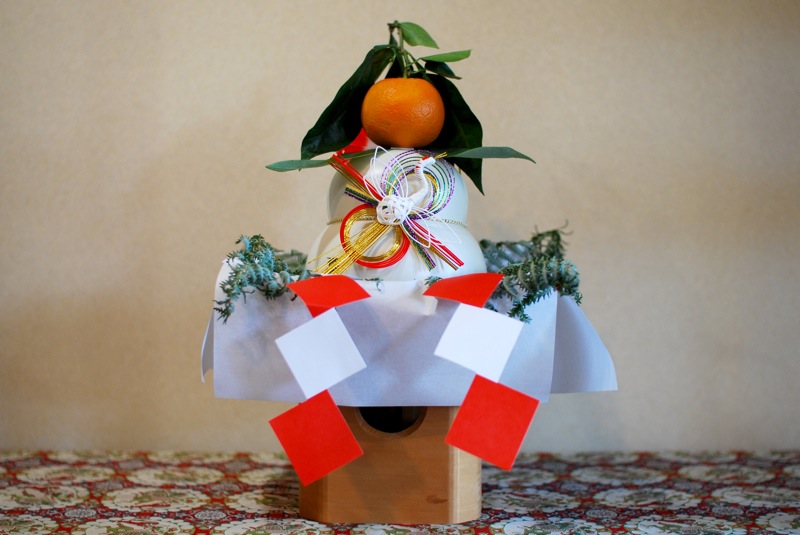
Elaborate Kagami Mochi (2008, CC2.0) Midorisyu

It is said they are stacked this way as the mochi represents the new and old years coming and going, the Daidai a continuing line of success for a family. Kagami-Mochi are placed in the Kamidana (Home Altar | 神棚 ) as an offering to allow the gods to be aware of the passing of the New Year, just in case they got too drunk on O-Miki ( Sacred Rice Wine | 御神酒) or something the night before and forgot to bestow blessings on the mortals. This was engaged as part of the Shinto ritual of Kagami Biraki ( Opening the Mirror | 鏡開き) where the Mochi is broken with a hammer into around the middle of January and eaten in small pieces. I presume the mirror part has something to do with Amaterasu's mythology(?) which used mirrors as a motif to entice Amaterasu from her cave to welcome the Spring, or a Seasonal Change allegory from Winter to Spring. They are also placed confusingly (Buddhism is pretty clear that the Buddha was not a god per se) on the Butsudan ( Buddhist cabinet | 仏壇 ) in honour of the family at New Year, a time which in Japan is meant to be spent with family.

Kagami first appeared in the 1300's CE, with the origins being rather murky, but are thought to relate in some way to the importance mirrors held to Japanese people in these times. Kagami-Biraki as a ritual was begun by Tokugawa Ietsuna ( 徳川 家綱 | 1641-1680) around the Kanbun period (1661-1673 CE) as an auspicious ceremony meant to aid him in victory over his enemies in a coming battle. Around 1884, the practice of Kagami-Mochi began to be used in Judo dojos as a way to celebrate the New Year, spreading later to Aikido, Karate and Jujutsu dojos as well. Traditional Kagami-Mochi were made by hand, but modern versions are sometimes made from plastic moulds, and the Daidai with a Mikan orange.

This concludes Perezoso blog posting.


Socials

Email :        learnjapanese43@gmail.com


Wikimedia: https://commons.wikimedia.org/wiki/User:LearnJapanese43


Discord :     @learnjapaneseforfree


Tiktok :       @learnjapaneseforfree


Youtube:     @learnjapaneseforfree /LJ43?

This review is part of the Learn Japanese for free project. I have, do not and never will derive any profit from this project. Please send any requests, questions or further information about free tools for learning Japanese to learnjapanese43@gmail.com which is checked totally sporadically becuase the originator is perezoso.

Saturday, 21 December 2024

Vocabulary #2 | Days of the Week | Learn Japanese For Free

 This vocabulary list is for the usual colours. Fun colour facts, in the past, Ao and Midori were often conflated. 赤ちゃん refers to a baby, most likely when it's red in the face. Traditionally there isnt a word for pink and orange, but there is the word for peach used often for pinks. Murasaki 紫式部 is used to denote one of the major pen names the British translator of the Tale of Genji gave to the author in 1926, as we dont know the exact name of the author, but rather as a part of the tales position as a member of the Fujiwara family (purple flower) and her father's position at the court as Shikibu (master of ceremonies).

Rainbow Bridge (2023, CC1.0/PD) Syced

Vocabulary

Red -  Aka / あか / 

Yellow -  Kiiro / きいろ / 黄色

Orange -  Orenji / オレンジ

Green -  Midori / みどり / 

Blue -  Ao / あお / 

Purple -  Murasaki / むらさき / 

Pink -  Pinku / ピンク

Rainbow -  Niji / にじ / 

Black -  Kuro / くろ / 

White -  Shiro / しろ / 


This concludes Perezoso blog posting.

Socials

Email :        learnjapanese43@gmail.com

Wikimedia: https://commons.wikimedia.org/wiki/User:LearnJapanese43

Discord :     @learnjapaneseforfree

Tiktok :       @learnjapaneseforfree

Youtube:     @learnjapaneseforfree /LJ43?

This review is part of the Learn Japanese for free project. I have, do not and never will derive any profit from this project. Please send any requests, questions or further information about free tools for learning Japanese to learnjapanese43@gmail.com which is checked totally sporadically becuase the originator is perezoso.

Sunday, 15 December 2024

Vocabulary #1 | Days of the Week | Learn Japanese For Free

This vocabulary list is for the Days of the Week. Nazenara, perezoso, atarashi no kotoba desu. In the old adage of if it aint broke dont fix it.


Diana as moon-goddess, i.e. Luna Selene (1529, PD) Rijksmuseum
The reason we call it Monday, because Moonday

Vocabulary

Monday -  Getsuyoubi / つようび / 月曜日

Tuesday -  Kayoubi / かようび/ 火曜日

Wednesday -  Suiyobi / すいようび / 水曜日

Thursday -  Mokuyoubi / くようび / 木曜日

Friday -  Kinyoubi / んようび / 金曜日

Saturday -  Doyoubi / ようび  / 土曜日

Sunday -  Nichiyoubi /  ちようび / 日曜日


Thus concludes Perezoso blog posting.

Socials

Email :        learnjapanese43@gmail.com

Wikimedia: https://commons.wikimedia.org/wiki/User:LearnJapanese43

Discord :     @learnjapaneseforfree

Tiktok :       @learnjapaneseforfree

Youtube:     @learnjapaneseforfree /LJ43?

This review is part of the Learn Japanese for free project. I have, do not and never will derive any profit from this project. Please send any requests, questions or further information about free tools for learning Japanese to learnjapanese43@gmail.com which is checked totally sporadically becuase the originator is perezoso.

Saturday, 7 December 2024

Signpost #1 | NINJAL | Learn Japanese For Free

This signpost is for Ninjals resource database. I would recommend it for all linguistic levels of learners. This is a resource for extrapolating on large database and survey results. The signpost series is the first in a new series of introductory articles expanding on linguistical tools for linguists working with, in, or around Japanese to utilise.

NINJAL site (2008, CC3.0) FOXiが撮影

What 

This is a giant compilation of data produced by NINJAL and catalogues and surveys available on the Japanese language from the institution.  

Some examples of data include loan-words, Diachronic studies, compound verbs, vocabulary in Romance languages, audio data, Corpora, spoken language processing, natural language processing, phonetics, psychology, sociology, Japanese education, dictionary compilation., dialects, collocation and hentaigana.

Where

Online at https://www.ninjal.ac.jp/english/resources/search/ 

Who

X belongs to its creator X persons. 

These all have many, many people involved in these projects whom I would love to highlight if they wish to be.

When

Available if you have internet.

Some research goes back to 1958.

Why

Nerds will know why.


Socials

Email :        learnjapanese43@gmail.com

Wikimedia: https://commons.wikimedia.org/wiki/User:LearnJapanese43

Discord :     @learnjapaneseforfree

Tiktok :       @learnjapaneseforfree

Youtube:     @learnjapaneseforfree /LJ43?

This review is part of the Learn Japanese for free project. I have, do not and never will derive any profit from this project. Please send any requests, questions or further information about free tools for learning Japanese to learnjapanese43@gmail.com which is checked totally sporadically becuase the originator is perezoso.


Sunday, 1 December 2024

New Word of the Week

Twas busy so new word of the day:

忘れちゃった!

I have forgotten!

Also lazyblogcore.

Socials

Email :        learnjapanese43@gmail.com

Wikimedia: https://commons.wikimedia.org/wiki/User:LearnJapanese43

Discord :     @learnjapaneseforfree

Tiktok :       @learnjapaneseforfree

Youtube:     @learnjapaneseforfree /LJ43?

This review is part of the Learn Japanese for free project. I have, do not and never will derive any profit from this project. Please send any requests, questions or further information about free tools for learning Japanese to learnjapanese43@gmail.com which is checked totally sporadically becuase the originator is perezoso.

RTK search engine

Hochanh is a website search engine for RTK. Its for all levels and comes in handy for searching through the garbled mess that is the origina...